

Hot Labor Summer Faces Cold Winter
Over the past several decades, corporations, with government support, have largely stomped out unions. Will a series of historic labor wins and record public support reignite their flame?
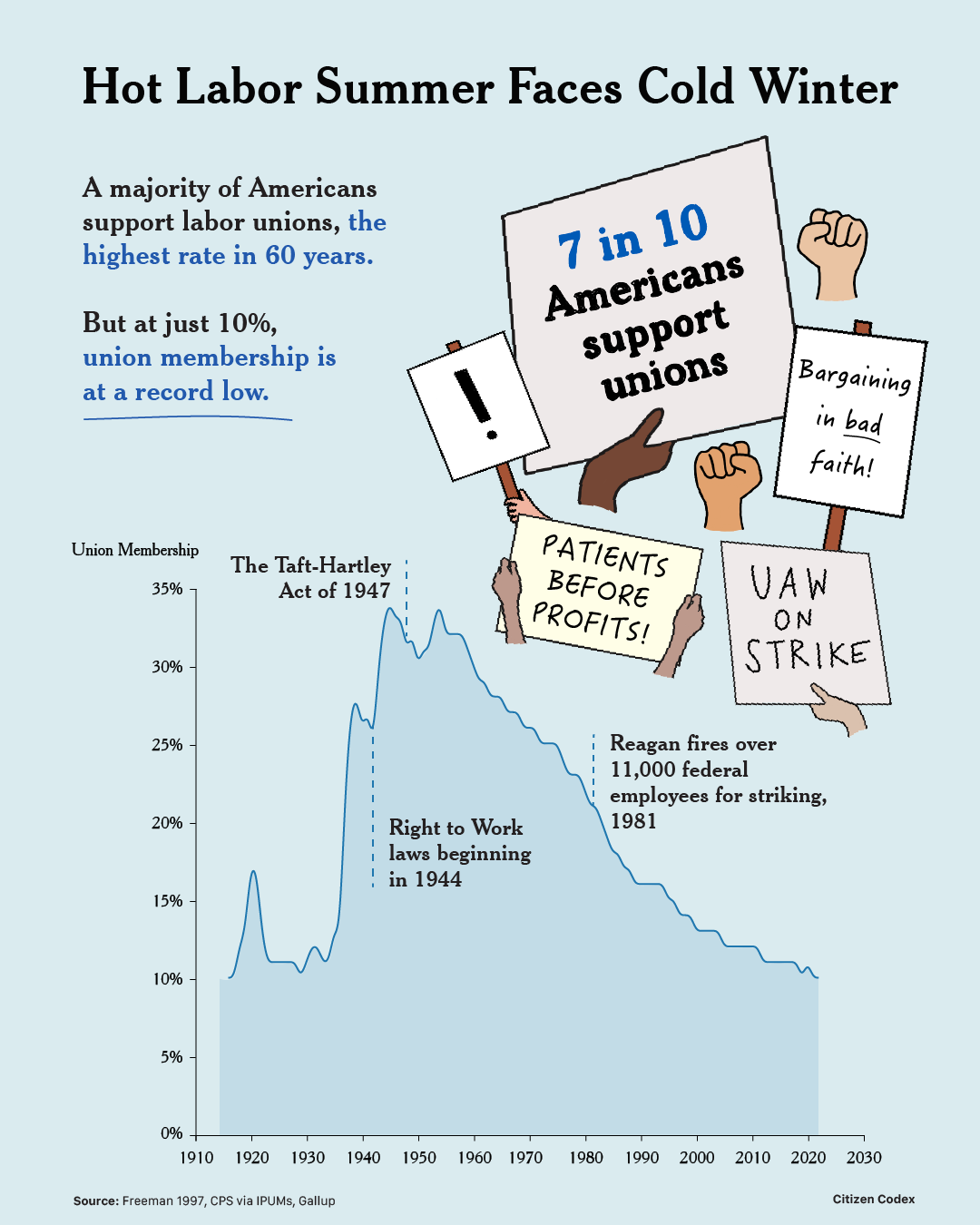
The recent United Auto Workers Strike (UAW) has piled on to a summer of record-breaking union activity. But casting a shadow over these victories is the reality that even if current labor organizers get everything they ask for— inflation-proof wages, pensions, health care— these gains will only affect a dwindling percentage of workers. The percentage of Americans belonging to a union is a fraction of what it once was. Amidst the media’s detailed coverage of employer-employee contract negotiations lies a bigger question that will determine the fate of the U.S. economy. Will unions rise again?
Organized labor is hot again.
In the last decade, public support for unions has skyrocketed from a record low to the highest rate in 60 years. This rise in approval has been accompanied by a series of historic wins for labor, with workers electing to form unions at major corporations including Starbucks, Amazon, REI, and the Apple Store. Bloomberg Law reported July 2023 to be one of the busiest months for labor strikes in decades, with over 650,000 workers threatening to walk out.
There are various reasons why Americans have begun to believe in the promise of unions again. Adjusted for inflation, wages have remained largely stagnant since the 1960s, with most gains going to higher-income earners. Stress levels at work have hit a record high. Young workers, who exhibit the highest support for unions, are particularly miserable.
And yet, while support for unions has soared, Gallup reported that less than 20% of workers are interested in joining one. In a world of immense economic dissatisfaction, many support workers from afar but do not see the value of collective bargaining in their own workplace. Today just 10% of workers participate in a labor union.
How the labor scales were tipped.
The decline of American unions is largely the result of government policy and globalization. Many historical analyses contribute the decline to the following actions by the U.S. government:
- Starved Budgets: Beginning in 1944, some states made it illegal for unions to negotiate a fair-share agreement in which non-union workers of a company would contribute part of their wages to union representation. These regulations, known as right to work laws, cut deeply into the budgets of unions, damaging their ability to fight for better wages. Today, 26 states, Guam, and the federal government have passed these types of laws.
- Government Regulation: The Taft-Hartley Act of 1947 greatly restricted how unions could form and bargain contracts. Sympathy boycotts, which had allowed unions to support workers in other industries, were outlawed. Though unions would face tighter scrutiny by the National Labor Relations Board, that same institution was given no power to punish employers for illegal, union-busting actions.
- Instilled Fear: When Ronald Reagan became president in 1981, he immediately fired over 11,000 federal employees for striking. The workers from the Professional Air Traffic Controllers Organization had gone on strike to protest long hours and low pay. The mass firing illustrated how weak collective bargaining power had grown in the wake of the Taft-Hartley Act and further discouraged new unions from forming.
In this restrictive climate, unions struggled to gain ground in new industries. Companies took notice. Emboldened by right-to-work laws and the Taft-Hartley Act, businesses acted decisively against labor, moving to anti-union states, campaigning against unionization, and suing unions for perceived misconduct.
The collapse of U.S. manufacturing in the 1970s and the advancement of labor-replacing technology further exacerbated the downward trend of union membership. In sectors like the telephone industry, companies offshored manufacturing jobs to regions with cheaper labor. In sectors of domestic production like coal mining, workers were replaced by more efficient extraction methods. Union workers who had bargained for better wages and benefits woke up to see their job disappear.
Will unions rise once more?
Whether unions benefit the economy is the subject of unending American debate. Opponents claim that unions lower the number of overall jobs by increasing the cost of doing business in the U.S. Advocates say that the higher rates of unionization in the 1940s and 1950s built the country’s famed middle class.
Regardless, it’s clear that today's workers have little right to decide for themselves whether they would benefit from a union. Current government policy allows companies to threaten their employees, fire agitators, and move business overseas when they see fit. American business has been concentrated into the hands of few all-powerful individuals. While organized labor has clearly earned the public’s support, the legal odds stacked against them have put their future in question.
Proposed legislation like The Protecting the Right to Organize Act - which, among other measures, would protect workers from employer retaliation, overturn right to work laws, and broaden the definition of employee to include “gig” workers, offers a glimmer of hope. This bill, however, has already stalled twice in the Senate, where it would need at least 60 votes to overcome a Republican filibuster.
Ultimately, the resurgence of unions will be largely determined by the will of the voter to level the playing field between worker and employee.
About the Data
Data on union membership prior to 1983 are taken from a 1997 working paper by the National Bureau of Economic Research that compiles various government reports. Union membership data following 1983 are sourced from the Current Population Survey earner study accessed via IPUMS. Survey data on public approval of unions in the U.S. are sourced from the Gallup Poll Social Series.
Want free access to these datasets to perform your own analysis and add to the conversation? Subscribe today!
The Team
Data Research & Story: Andrew Fleming
Design: Anna Davis
Editor: Nicole Varela