
Embracing Innovation: The Rise of AI / ML in the Federal Government
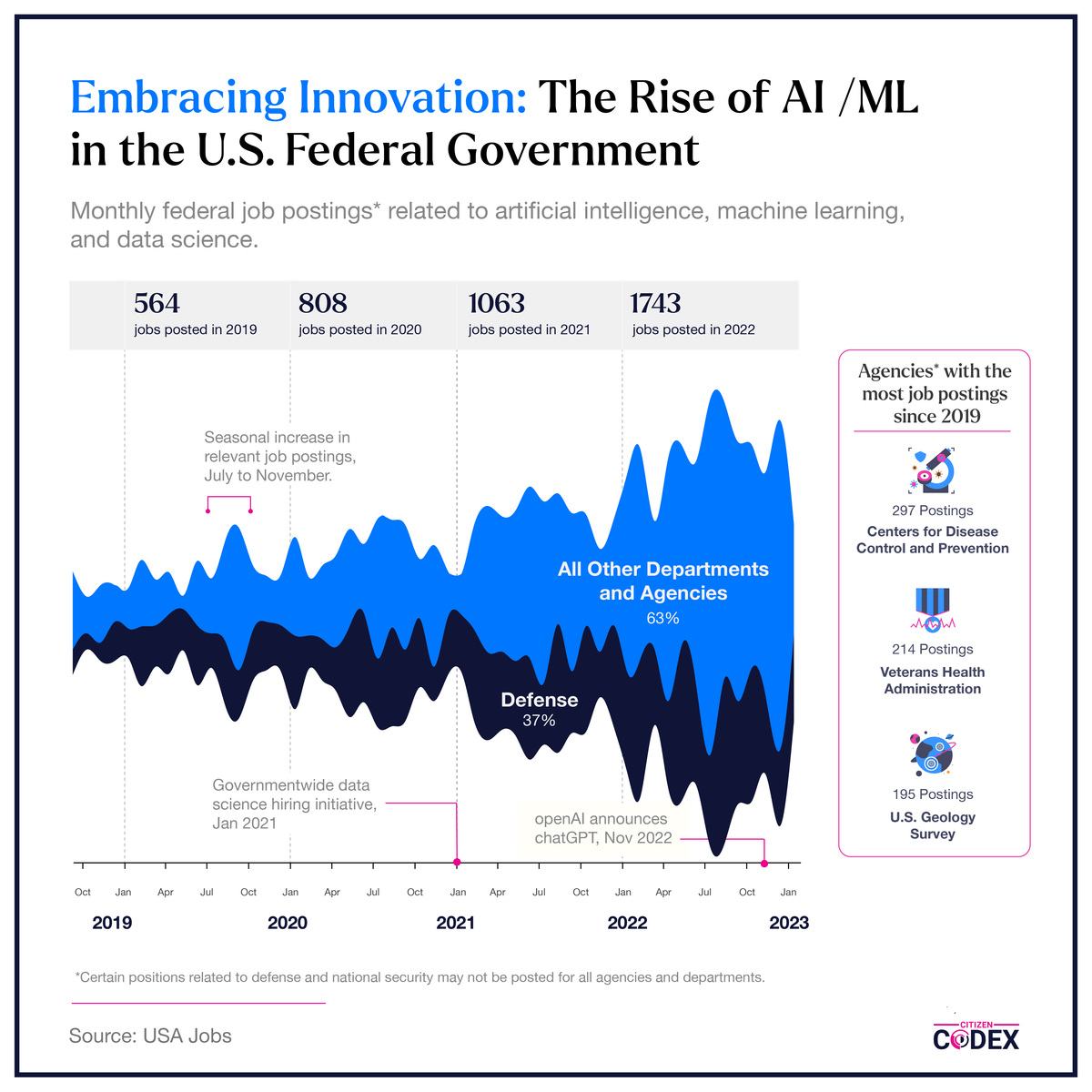
With all the passion and heat around artificial intelligence (AI) and machine learning (ML), as well as the attention paid to it by political leaders, it begs the question: what is the US federal government, the largest employer on the planet, up to on the topic.
One interesting measure? Federal job postings.
Publicly available data from USA Jobs on more than four thousand postings over the past five years related to artificial intelligence, data science, and machine learning—extracted and parsed based on job titles and job descriptions—reveals rapid, upward growth of job openings.
And while there are seasonal patterns to when these jobs are posted, which swell in the July to November timeframe, the growth in postings over time is consistent across many different types of agencies. The Centers for Disease Control, the Veterans Health Administration, and the U.S. Geological Survey all emerged as leaders in the race for AI/ML talent aside from the traditional defense agencies.
For those familiar with the inner workings of the US federal government, this is only part of the story.
Large swaths of the defense, security, and intelligence community of agencies do not utilize USA Jobs (e.g., CIA, FBI). Furthermore, for every civilian employee, there are roughly two to three contractors employed by the federal government, roles which are also not captured in USA Jobs.[1] And while the effect of artificial intelligence on the federal contractor employment base remains to be explored, many of the publicly available AI use cases described at ai.gov were built by contractors.
The surge in demand for AI/ML hiring is clear, as the 46% annual growth rate demonstrates. There are several possible catalysts for this:
- Law and Policy. Congress’s passage of the Foundations for Evidence-Based Policymaking Act of 2018 motivated significant action and investment in using data for decision-making. Executive Orders 13859 and 13960 likely spurred further action, working respectively to establish a comprehensive national strategy for AI and creating the National Artificial Intelligence Initiative.
- Leadership. The creation of and hiring for the Chief Data Officer (CDO) roles across many Departments and Agencies empowered key decision makers to think strategically about the future of AI in government. In January 2021, OPM and the Federal Chief Data Officers Council put out a governmentwide consolidated data science job application that received over 500 applications in the first 48 hours.
- Crisis. The data and analytics frenzy spurred by COVID with leaders hungry to understand not just the state of the disease, but the influence of the pandemic on different aspects of the economy, the country, and the world. This likely explains why the CDC had the highest number of job postings across all non-defense agencies.
Then of course there’s chatGPT. Most of the activity observed in USA Jobs occurred before the frenzy caused by OpenAI's announcement of chatGPT in November 2022. The interest and demand triggered by chatGPT in Large Language Models, and AI more broadly, is likely to increase demand for use of AI/ML models; and also generate a whole new class of federal jobs, such as AI auditor, machine manager and prompt engineer.
All evidence suggests the tornado of job postings focused on AI/ML will continue to rise rapidly across the US federal government for years to come.
About the Data
USA Jobs is the official job portal of the United States federal government. It provides a comprehensive listing of job vacancies available across agencies, job fields, and locations. The team extracted a historic data pull of all open job postings, from 2018 onward, and parsed the data using a simple keyword search across job descriptions. Keywords included: “data science”, “artificial intelligence”, "advanced analytics" and “machine learning”.
Want free access to these datasets to perform your own analysis and add to the conversation? Subscribe today!
The Team
Data Research: Maxwell Titsworth
Story: Nicole Varela
Design: Martha Williams
Editor: Biniam Gebre