
The American Public Transit Dilemma
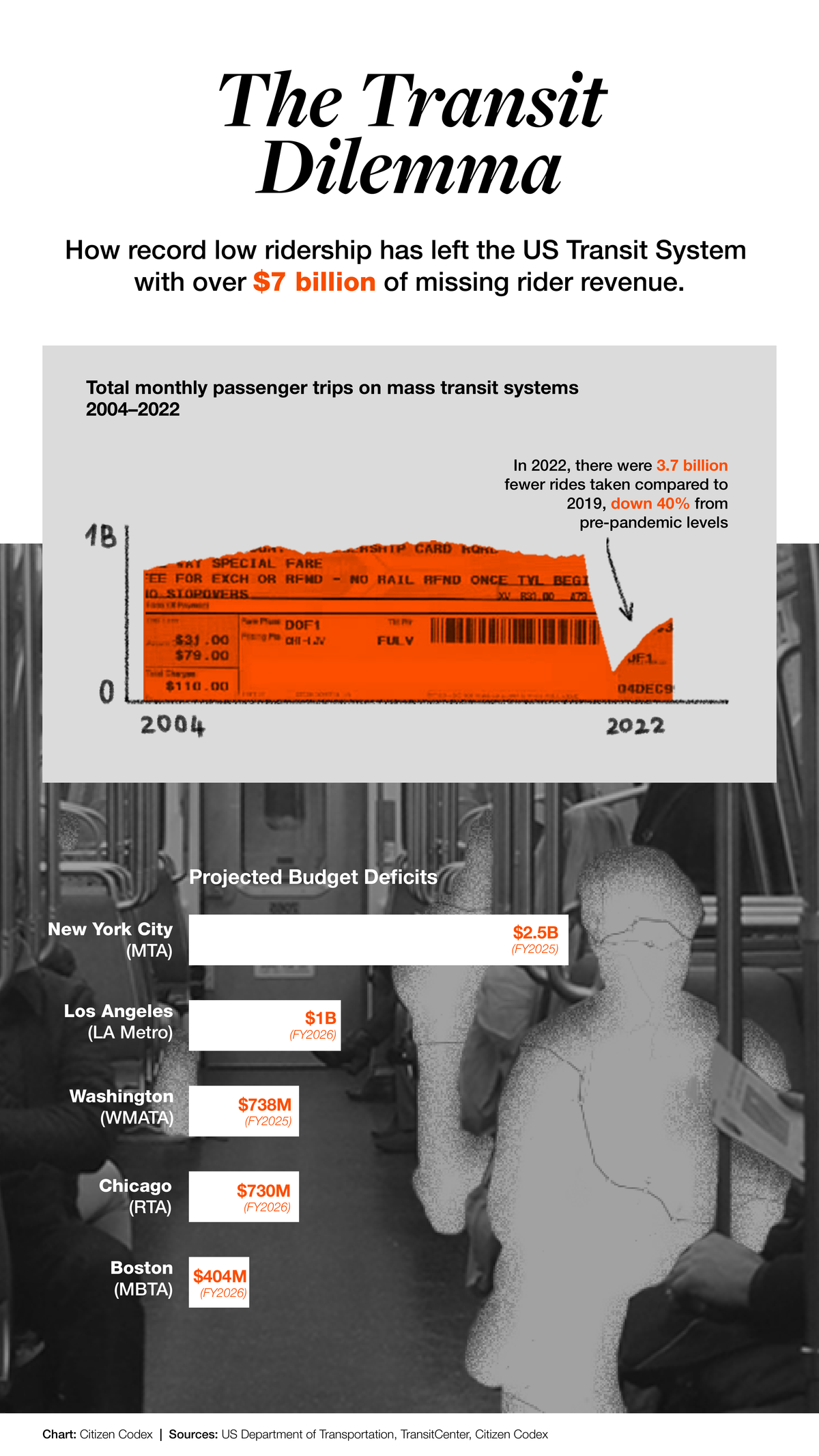
Transit use is down everywhere. Agencies are getting creative.
Riders rejoice. From California commuter rails to New York City’s hundred-year-old train lines, transit is now less crowded. Even during the morning rush hour, it may be possible to find that coveted subway or bus seat. While this is seemingly welcome news for riders, each empty seat is lost revenue for the system as a whole. This translates to reduced schedules, service cuts, lay offs, and a hollowed out transit system.
This is the new reality for transit agencies across the United States.
According to an analysis of the Department of Transportation’s National Transit Database, more than 95% of transit agencies are operating below pre-pandemic ridership. Nationally, ridership is two-thirds of what it was prior to the pandemic. For some transit agencies, the picture is even bleaker. San Francisco’s Bay Area Rapid Transit (BART) system, which used to serve 400k riders daily, now serves a third of that. Some smaller agencies have cut service entirely.
The most obvious effect is that low ridership levels translate to lost fare revenue. Based on the decline in total ridership between 2019 and 2022, and using the national average fare revenue from 2019, the lost revenue from missing riders is roughly $7 billion for 2022.
This substantially decreased ridership, the associated revenue lost, and the slow recovery to pre-pandemic ridership levels has stoked fears of the collapse of American mass transit.
Lost fare revenue has already forced agencies to cut back on service and raise fares. This, in turn, could drive down ridership further. A weakened transit system places yet another burden on poor and working families and presents additional headwinds towards broad decarbonization efforts.
To be sure, the challenges of mass transit in the United States began well before the pandemic. In the early 20th century, mass transit was the dominant form of transportation in every American city.[1] But the expansion of the suburbs, mismanagement by transit authorities, and the embrace of the personal vehicle by both industry, government, and mass culture killed most large transit systems in the United States, outside a few core cities.
More recently, after a brief surge in the early 2000s, mass transit system ridership began to plateau and decline in the 2010s for a few reasons.
- Rideshare companies such as Uber and Lyft, served as effective substitutes for many riders.
- Gentrification and cost-of-living increases have also pushed families out of transit accessible neighborhoods, reducing the number of potential riders.
- Lastly, historically low car and gasoline prices made personal vehicles more affordable.
Now, in this post-pandemic era, ridership is down everywhere, all the time, all at once. This is a process still in motion, but a few theories have emerged to explain this historic shift. Of course, a mass shift to remote work removes the necessity of any type of transportation. Even miles traveled by personal vehicle use is still down, three years later. But the availability of rideshare and the continued cost-of-living challenges of transit rich cities are likely also playing a role.
Transit agencies are then faced with an enormous challenge: how to bring back riders in the face of the emerging structures of post-pandemic life.
The strategies vary. Transit planners have long advocated for a re-focus on a core competency of transit systems: frequency. Decades of research has shown that frequency, above all system attributes, is the main driver of ridership. [2] It reduces the inconvenience of wait times for transfers and makes the issue of mechanical breakdowns nearly obsolete.
Still, some agencies have tried to increase ridership by embracing, rather than fighting, rideshare. Dozens of agencies have launched or doubled-down on their fleet of vans, cars, and other demand-response vehicles to meet riders where they’re at. Tampa, Florida, not known for being a transit hub, has seen a 20% increase in ridership since before the pandemic, primarily through its agency-run rideshare program.
A few agencies have taken an even more radical approach to increase ridership: abolish fares altogether. For smaller agencies where fare revenue provides a small fraction of total operating cost, this has some logic. Tucson, Arizona has seen a 10% increase in ridership post-pandemic after abolishing fares and is working with local partners to make this pilot permanent.
Whatever the solution, in nearly every city, transit in the United States finds itself at the precipice. The decisions of lawmakers and policy makers will determine its fate for years to come. And its not clear relying on Taylor Swift to save every transit system is the most viable strategy.
About the Data
The data is sourced from the Department of Transportation's National Transit Database (NTD). Most transit agencies in the country are required to report ridership, revenue, and other operating metrics to the Department of Transportation on a monthly basis. The team used April 2023's reported metrics to estimate change over time and used the 2019 metrics file to extract the average fare revenue for pre-pandemic transit operations.
Want free access to these datasets to perform your own analysis and add to the conversation? Subscribe today!
The Team
Data Research & Story: Maxwell Titworth
Design: Chloe Phan
Editor: Biniam Gebre