
The Black-White Unemployment Gap is Close to Closing for the First Time in History. Why?
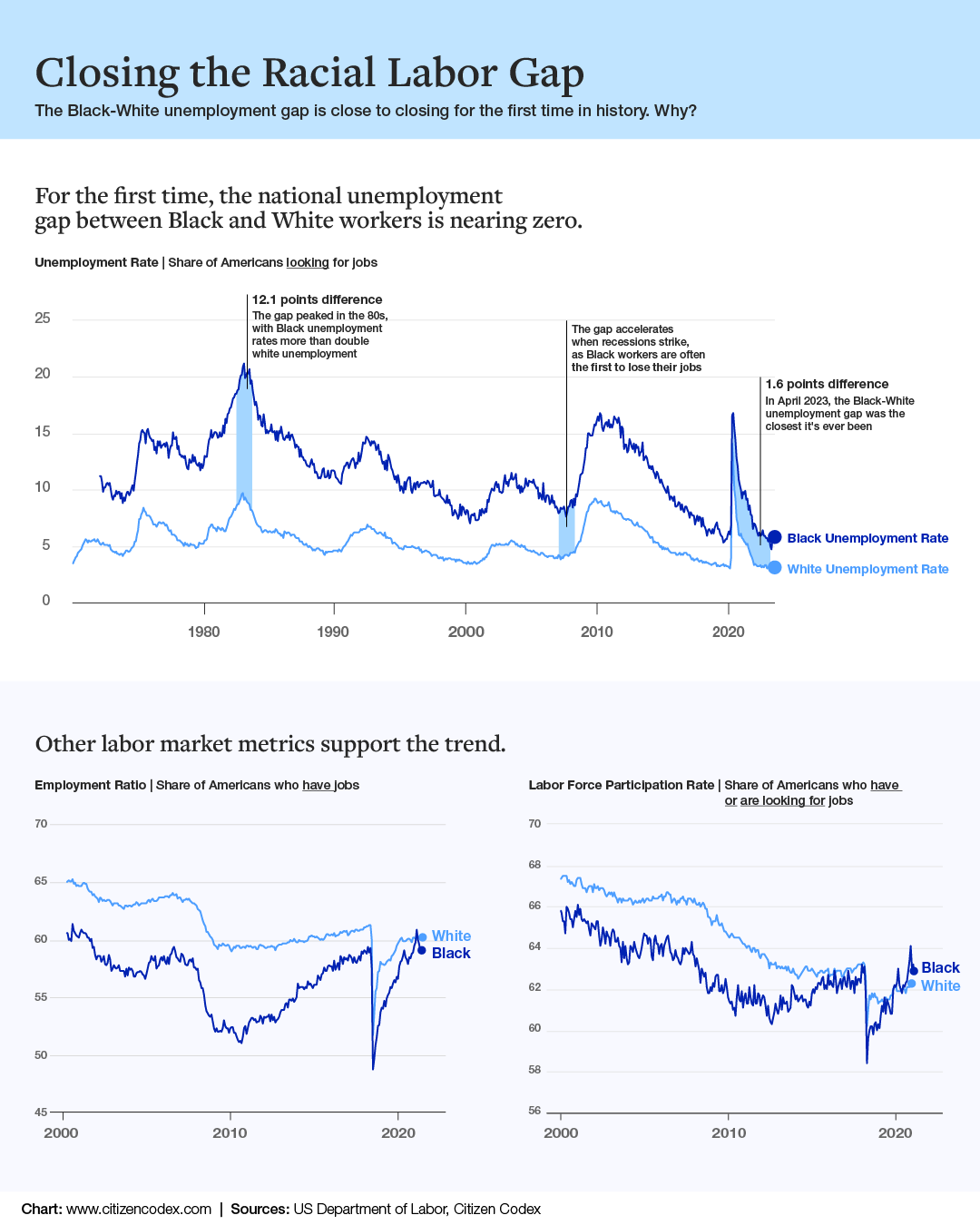
In the study of labor markets, few trends are as persistent as the unemployment gap between white and non-white workers. Discrimination, lack of local job opportunities, and education barriers have kept the gap wide open for most of recent United States history.
This gap is even more pronounced for Black workers, where on average the Black unemployment rate is often twice as high as the white unemployment rate. This gap accelerates when recessions strike, Black workers are often the first to lose their jobs compared to white workers. This gap persists across geographies, gender, and historically, time.
But for the first time, the national unemployment gap between Black and white workers is nearing zero. Why?
To understand this gap, we must first understand what we mean by unemployment. The federal Bureau of Labor Statistics (BLS) defines unemployed people as “people who are jobless, looking for a job, and available for work.” Contrary to popular belief, unemployment is not people sitting around, waiting for a government check, but folks actively looking for work—as officially defined by BLS.
For as long as BLS has collected data, Black folks and many other non-white Americans have actively looked for work but have been unable to obtain it at the same rate as white Americans. Formal work, an integral path toward economic mobility in the US market economy, has historically been difficult to secure for many, until now.
So why is the gap near to closing now? From BLS data and research by social scientists, a few theories emerge:
- A Hot Labor Market: The American labor market is the hottest it has been in recent memory. Since October 2021, for every 6 people looking for jobs, there have been roughly 10 jobs available, according to BLS. To keep pace, employers have had to expand beyond their traditional recruitment networks to find talent. One signal of this has been the push by employers to recruit from historically black colleges and universities (HBCUs). Every time the labor market tightens, Black workers make gains.
- Declining Incarceration Rates: The gradual unwinding of the carceral system and related efforts have begun to remove barriers to employment for many. Experience with the prison system, which disproportionally affects Black people (by a factor of five times), poses a significant challenge for people seeking employment by robbing years of workforce development and posing reintegration challenges. But since 2009, prison populations and imprisonment rates have decreased, partly due to state-led drug decriminalization. Additionally, legislation banning the collection of criminal history by employers has also reduced discrimination. These combined efforts may have historically improved Black people’s access to employment.
- A Shifting Black Workforce: The Black workforce itself has changed. As higher education and training opportunities have expanded, more Black workers have been able to enter a diverse range of occupations. A recent White House Council of Economic Advisers analysis found that Black workers have seen shifts towards a broad array of industries and away from less volatile sectors like hospitality. This shift has given the Black workforce more opportunities for employment and made it more resilient to economic and sector shocks, ensuring that the gains made during periods of growth aren’t entirely wiped out in the next recession.
- A Shifting White Workforce: Perhaps one of the longest-running shifts in labor markets is the steady decline in white labor force participation. In 2023, labor force participation exceeded pre-2007 recession levels for Blacks, while labor force participation for whites was where it was during the worst period of the 2007 recession. As the white population of the United States ages, retires, and shrinks, there are simply fewer white people working. These workforce exits have translated to higher employment rates of non-white workers, even before the hot labor market of today.
In this post COVID economy, it is increasingly difficult to predict how the labor markets will evolve. Whatever the explanation for the narrowing of the gap between white and Black unemployment, it seems likely they are structural, rather than temporary.
And if it is the case that there is growing equality in the opportunity to join the labor market and earn wages, it will be interesting to see how the broad questions being asked about equity of pay and distribution of wealth evolve over the years to come.
About the Data
Data is sourced from the Department of Labor's Bureau of Labor Statistics (BLS) via the Federal Reserve's data tool (FRED). BLS estimates on labor force participation, unemployment, and employment ratio are drawn from regular representative nationwide surveys. For more information, visit the BLS's unemployment research center.
Want free access to these datasets to perform your own analysis and add to the conversation? Subscribe today!
The Team
Data Research & Story: Maxwell Titworth
Design: Chloe Phan
Editor: Biniam Gebre