
The Middlemen of US Foreign Assistance
Despite the US government’s attempts to empower foreign aid recipient countries, most funds still flow through US and Europe based third parties.
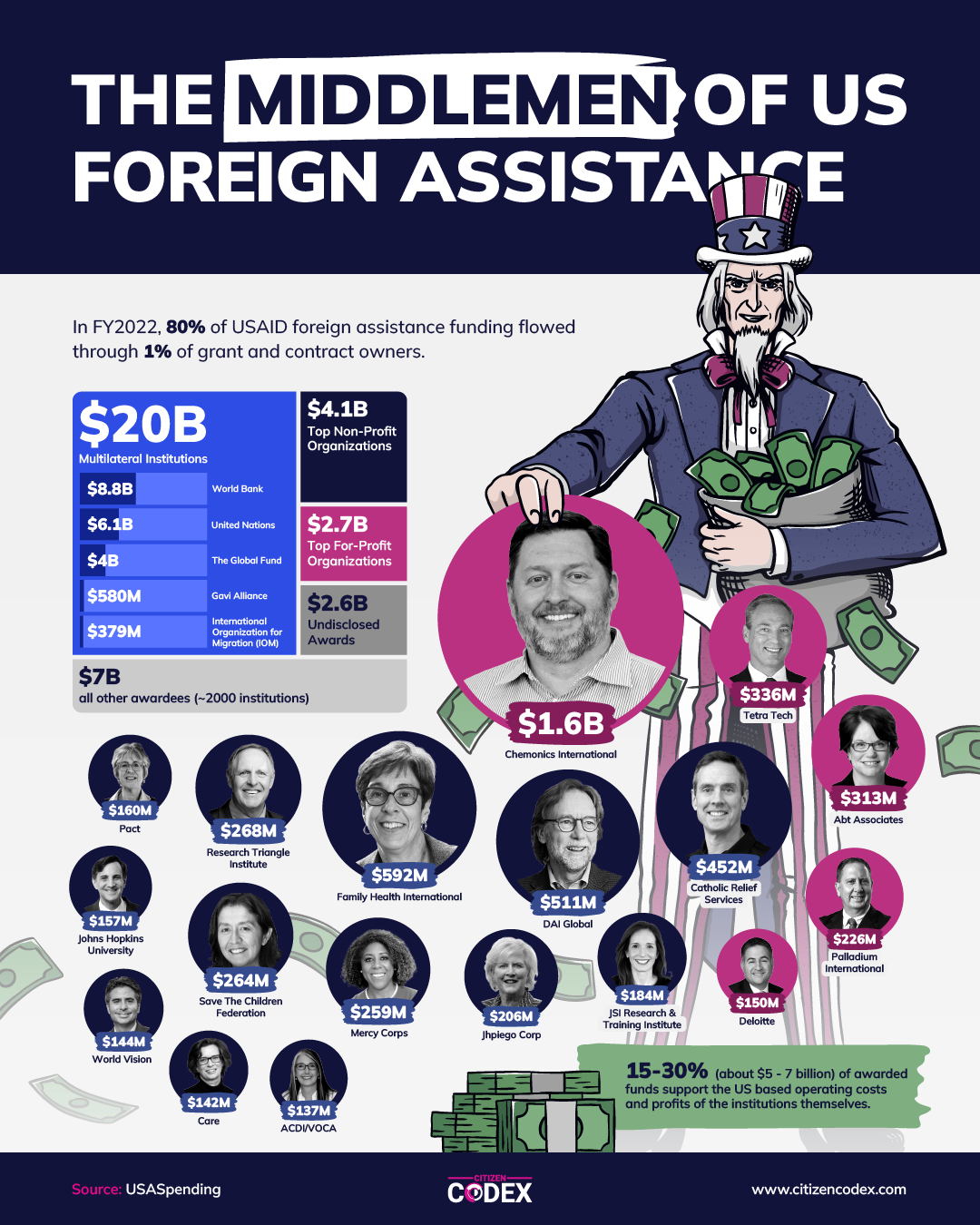
For the past several decades, the US government has made numerous attempts to change how it approaches foreign aid with the goal of being in greater sync with the people in the countries it aims to support. In the current administration, the US Agency for International Development (USAID), America’s foremost non-military foreign aid organization, has aimed to achieve this elusive goal by targeting how many grants and contracts go directly to funding locally registered organizations in recipient countries.
The policy goal of this process, also known as localization, is to shift “funding and decision-making power to the people, organizations, and institutions that are driving change in their own countries and communities.” A key step towards “equity, effectiveness, and sustainability.”
The long-running debate on aid effectiveness combined with the role of aid policy in the competitive context of US-China relationship dynamics gives these issues further urgency.
But of the $36 billion that USAID obligated to third parties last year, only $1.6 billion went to locally registered organizations directly. What happened to the other ~$34 billion?
The Intermediaries
USAID spending is intended to benefit over 100 countries worldwide. This spending has a myriad of objectives, including addressing humanitarian crises, improving health outcomes, enabling economic growth, and advancing democracy.
A closer examination of the data illuminates how funds flow from taxpayers through USAID to achieve the above intended benefits. More than 2,000 institutions received direct grants and/or procurement contracts. Approximately 1% of those institutions, almost entirely based in the US, received roughly 80% of the $36 billion in funds.
These handful of top awardees, illustrated in the above graphic, come in three distinct flavors:
- Multilateral institutions and public-private partnerships like the Gavi Alliance and the World Bank, who aggregate money from multiple sources and then distribute those funds to contractors and governments to achieve various objectives.
- Non-profits like Catholic Relief Services and World Vision, that provide services ranging from humanitarian relief to health service delivery and rely on fundraising and their non-profit tax status.
- For-profit entities like Chemonics and Palladium, who are privately held, provide a diverse set of services primarly through procurement contracts and realize a profit margin from the revenue they generate.
Power, Authority, and Wealth
Given the billions of dollars that are flowing through these organizations, how should their role be understood in the context of the policy goal of "...shifting funding and decision-making power to the people, organizations, and institutions that are driving change in their own countries and communities?”
There are two considerations:
- Flow of funds. According to several studies and reports, roughly 15-30% of obligated funds support the global operations and administration of these institutions. Most administrative functions and major leadership roles are staffed primarily in the West. In addition, the for-profit intermediaries also capture additional profit margin that accumulates to those US-based operations. By extension, billions of dollars that are obligated by USAID do not make it to the countries of policy interest when that money flows through these intermediaries. Over the past decade, the US provided more than $200 billion of foreign assistance to recipient countries. This means roughly $30-$60 billion of those funds remained mainly in the US.
- Power and Authority. For anyone who has worked in an organization of more than a dozen people, it becomes quickly clear who has power and decision authority and who doesn’t. This is especially true for decisions associated with resource allocation: who gets how much money, who gets to hire whom, which projects are taken on, what is the strategic posture of the organization, and whether to purchase certain items. In the case of USAID’s intermediaries, most of the individuals making these decisions are often US or European-based staff, far from the countries where the projects are being implemented or funding is supposed to go.
The data are at odds with USAID’s policy objectives. Some have argued that it’s risky, difficult, or will take a long time before locally registered organizations reach a level of maturity that can handle the volume of funds.
If this is the case, why aren’t the current set of large intermediaries shifting their operations and headquarters to the countries that are meant to benefit from the foreign assistance taxpayers are providing? Why aren’t they hiring all their staff for global operations in the countries that are meant to benefit from foreign assistance? Why are their leadership ranks not filled with people in the countries that are meant to benefit from this work?
Without consideration for these questions, USAID's goals of 'localization' are likely to remain aspirational and the US government's foreign policy goals of enabling local ownership a long held, distant dream both for the United States and the citizens of the countries it wants to support.
About the Data
Data is sourced from the USA Spending and includes FY2022 obligations for both contract and grant awards. For more information, visit usaspending.gov.
Note on the estimation of costs:
Unfortunately, the data on costs and profits is opaque, including for the for-profit institutions which are all privately held. However, a study published for the National Library of Medicine on funding for HIV programs concluded a broad range of indirect operating cost rates from 10% to 36%. Additionally, we apply average corporate profits to the for-profit institutions, of 6.6 %, based on the reports from the Bureau of Economic Analysis, which produces consolidated results across the US economy for corporate profits.
Want free access to these datasets to perform your own analysis and add to the conversation? Subscribe today!
The Team
Data Research & Story: Biniam Gebre
Design: InfoWithArt
Editor: Maxwell Titsworth